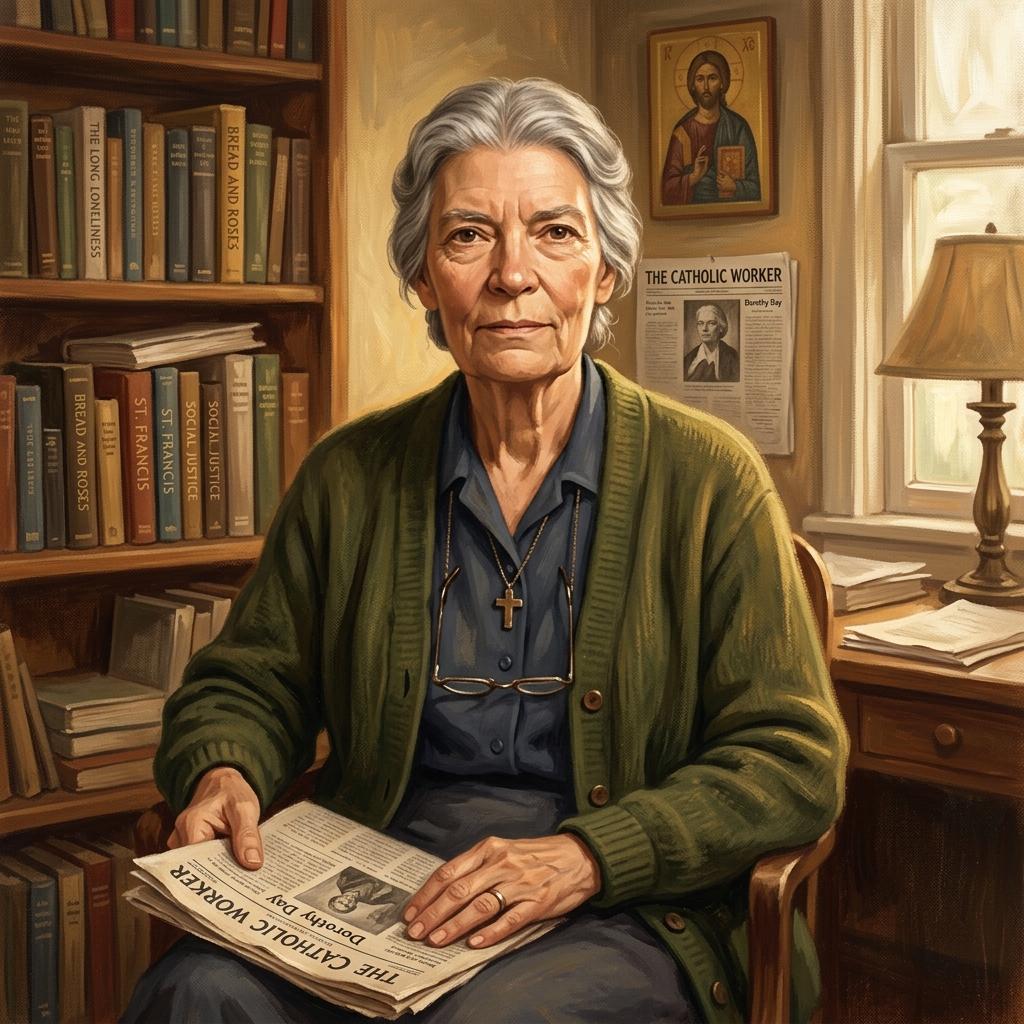
Dorothy Day
Peace, poverty, prayer, and the Catholic Worker — the life of one of the most radical Christians of the twentieth century.
Who she was
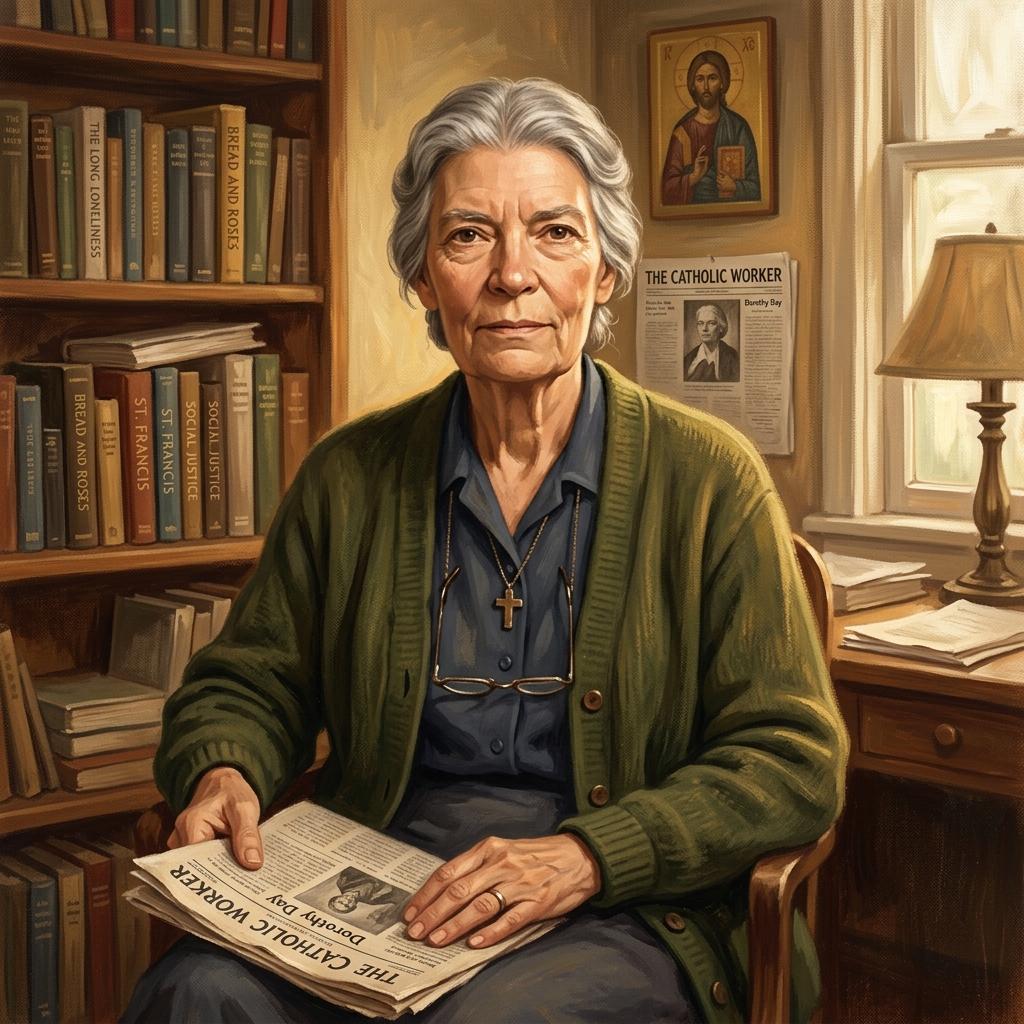
Dorothy Day (1897–1980) was an American journalist, social activist, and Catholic convert who co-founded the Catholic Worker movement in 1933. She spent her life serving the poor, opposing war, and challenging both church and state to live up to the Gospel.
Born in Brooklyn, New York, Day grew up in a nominally religious household and became involved in radical politics as a young woman. She worked as a journalist for socialist newspapers, was arrested for suffragist protests, and lived a bohemian life in New York City.
Her conversion to Catholicism in 1927 — prompted in part by the birth of her daughter Tamar — surprised everyone who knew her. She gave up a common-law marriage, left her radical literary circle, and entered a church that she knew would demand everything from her.
Key beliefs
Day's theology was simple and uncompromising:
- The works of mercy are not optional. Feeding the hungry, sheltering the homeless, and visiting the imprisoned are direct commands of Jesus, not suggestions for the exceptionally generous.
- Voluntary poverty is a Christian calling. Day lived simply her entire life, sharing the conditions of the people she served.
- Pacifism is non-negotiable. Day believed that the Sermon on the Mount forbids all violence — including war. She opposed every American war of her lifetime, including World War II.
- The state is not the solution. Day was critical of both capitalism and communism, arguing that the Gospel demands a revolution of the heart, not a change of regime.
Peace witness
Day's pacifism was her most controversial position. When she published an editorial in The Catholic Worker opposing American entry into World War II, circulation dropped from 190,000 to 50,000. Workers left. Houses closed. Day did not flinch.
“Our manifesto is the Sermon on the Mount.”
— Dorothy Day
She later opposed the Korean War, the Vietnam War, and the nuclear arms race. She was arrested multiple times for civil disobedience, including refusal to participate in Cold War air raid drills. In her seventies, she joined César Chávez's farmworkers' picket lines in California and was arrested for the last time at age 75.
Day did not separate her peace witness from her daily life. She lived with the poor, prayed the rosary, went to daily Mass, and practiced the works of mercy until the end. For her, peace was not a political position — it was the Gospel lived out.
The Catholic Worker movement
In 1933, Day met Peter Maurin, a French peasant philosopher who shared her vision of a society built on the principles of the Gospel. Together they launched The Catholic Worker newspaper, which they sold for one penny — a price that has never changed.
From the newspaper grew a movement: houses of hospitality where the poor could find food, shelter, and dignity; farms where workers could live in intentional community; and a network of activists committed to nonviolence, voluntary poverty, and the works of mercy.
Today there are over 200 Catholic Worker communities around the world. Each is independent, self-funded, and rooted in the same principles Day and Maurin established nearly a century ago.
Selected quotes
“Don't call me a saint. I don't want to be dismissed so easily.”
“The greatest challenge of the day is: how to bring about a revolution of the heart, a revolution which has to start with each one of us.”
“I really only love God as much as I love the person I love the least.”
“We have all known the long loneliness, and we have found that the answer is community.”
“The only way to live in any true security is to live so close to the bottom that when you fall you do not have far to drop, you do not have much to lose.”
Recommended reading
- The Long Loneliness — Day's autobiography and the best introduction to her life and thought.
- Loaves and Fishes — Day's account of the early Catholic Worker movement.
- Dorothy Day: A Biography by Jim Forest — the standard biography.
- All the Way to Heaven: The Selected Letters of Dorothy Day — her correspondence reveals the person behind the public figure.
Explore the broader context of Day's work in our guide to the Catholic Peace Tradition.
Continue with prayer
Peace begins with attention. Build a daily habit of pausing for prayer before distraction.
Explore Prayer Lock