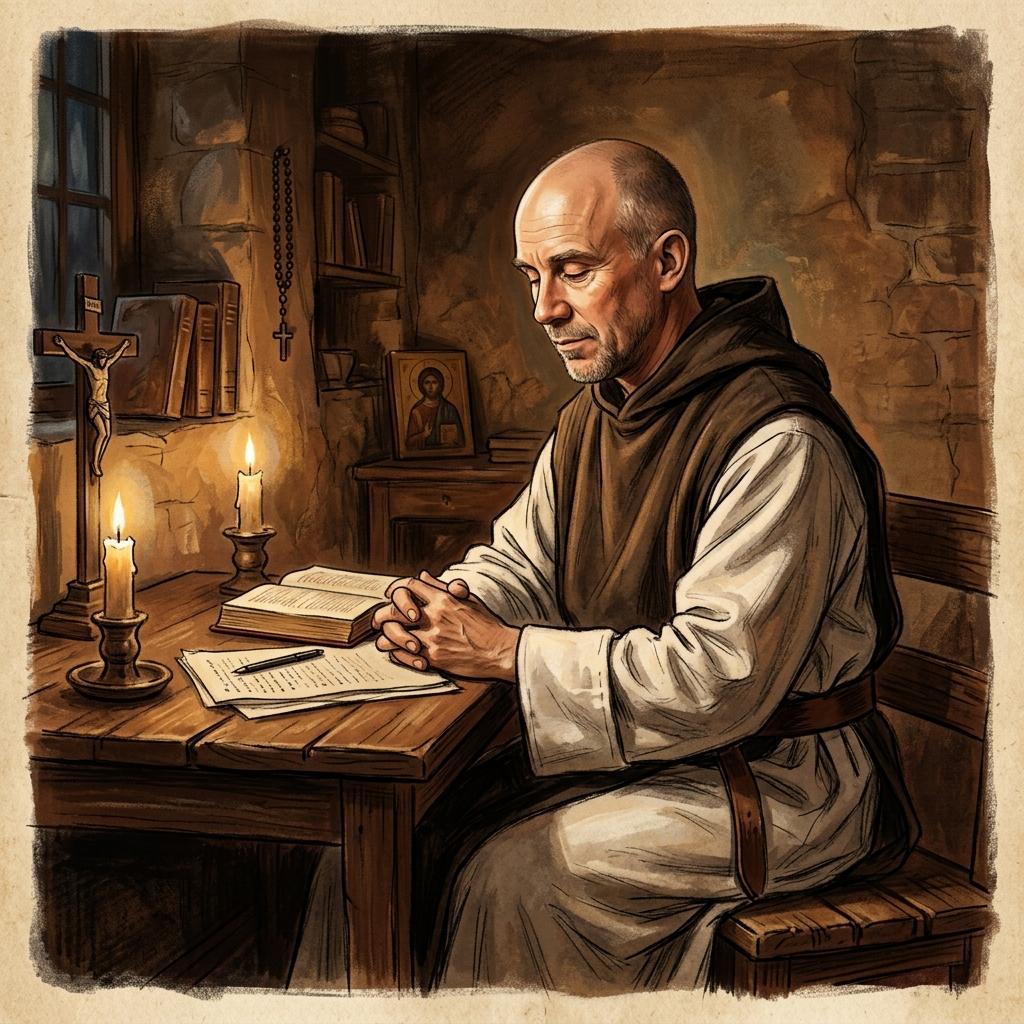
Thomas Merton
On peace, prayer, and the inner life — how a Trappist monk in Kentucky became one of the most prophetic Christian voices of the twentieth century.
Who he was
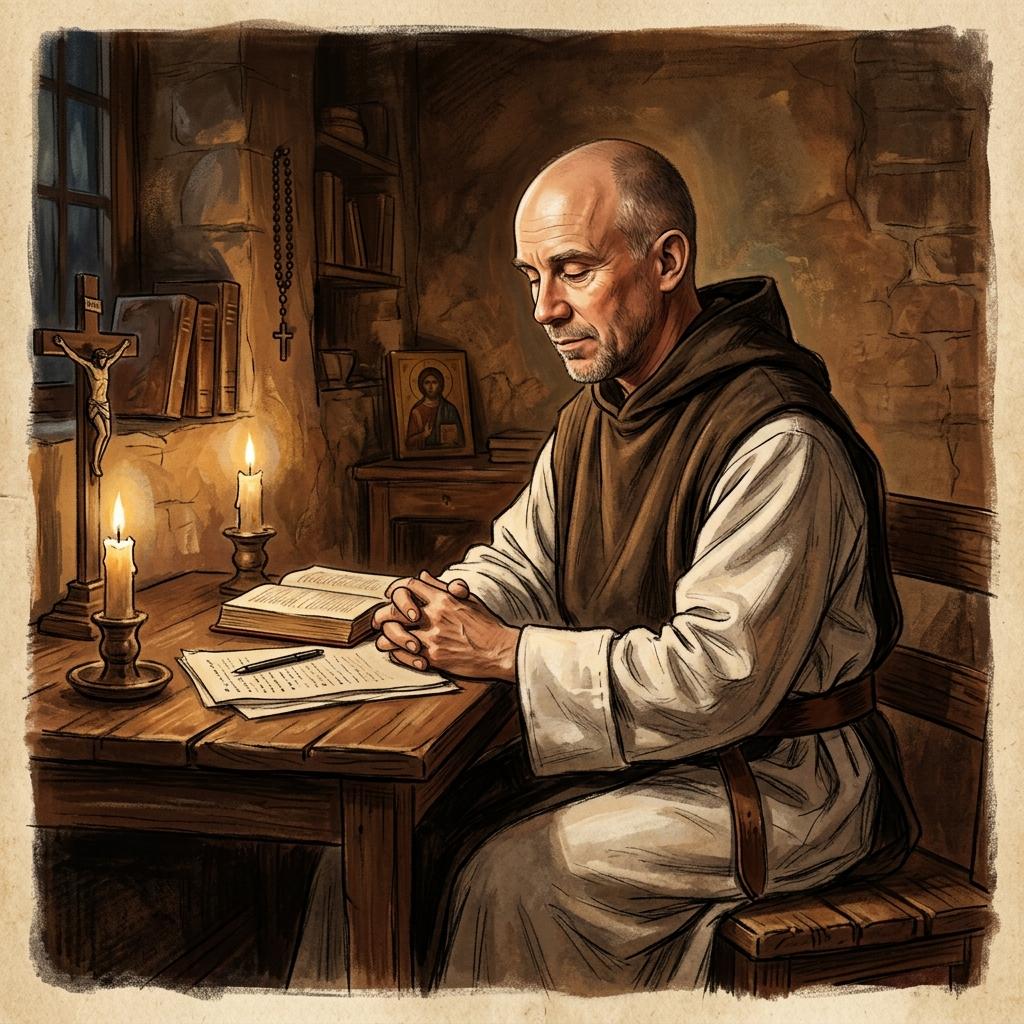
Thomas Merton (1915–1968) was a Trappist monk, writer, poet, and social critic. He entered the Abbey of Gethsemani in Kentucky in 1941 and spent the rest of his life there — writing over 70 books on contemplation, spirituality, nonviolence, and the human condition.
Born in France to an American mother and a New Zealand father, Merton grew up across Europe and the United States. After a restless youth — marked by the early deaths of both parents, academic brilliance, and a dissolute period at Cambridge — he converted to Catholicism in 1938 and entered the monastery three years later.
His autobiography, The Seven Storey Mountain (1948), became a surprise bestseller and introduced millions of readers to the contemplative life. But Merton was far more than a devotional writer. Over the following decades, he engaged with questions of war, race, technology, interfaith dialogue, and the nature of the self with a depth and urgency that few religious writers have matched.
Contemplation and peace
For Merton, contemplation and peacemaking are inseparable. Violence, he argued, springs from the disordered self — from fear, ego, the compulsive need to control, and the refusal to see the image of God in the other. Peace begins not with political programs but with inner transformation.
“We are not at peace with others because we are not at peace with ourselves, and we are not at peace with ourselves because we are not at peace with God.”
— Thomas Merton
This does not mean that contemplation is an escape from the world. Merton was emphatic that true contemplation leads to greater engagement, not less. The monk who encounters God in silence is compelled to encounter God's image in every human face — including the face of the enemy.
Critique of violence
In the early 1960s, Merton turned his attention to the nuclear arms race. His writings on war — particularly Peace in the Post-Christian Era— were so provocative that his Trappist superiors forbade him from publishing on the topic. He continued writing, circulating his essays privately in mimeographed form (what he called his “Cold War Letters”).
Merton argued that the willingness to destroy entire civilizations in nuclear war represented not strength but profound spiritual sickness. He saw the arms race as a symptom of a deeper problem: humanity's inability to face its own inner violence.
“The root of war is fear: not so much the fear men have of one another as the fear they have of everything.”
— Thomas Merton, New Seeds of Contemplation
He corresponded with activists including Dorothy Day, Daniel Berrigan, and Martin Luther King Jr. — connecting the contemplative tradition with the movements for peace and civil rights.
Solitude and attention
Merton spent the last years of his life as a hermit on the grounds of Gethsemani, living in a small cinder-block building he called his “hermitage.” It was there that he produced some of his most profound writing — on solitude, silence, and the nature of attention.
He saw the modern world's addiction to noise and stimulation as a form of violence against the self. In a passage that feels startlingly contemporary, he wrote:
“There is a pervasive form of contemporary violence to which the idealist fighting for peace by nonviolent methods most easily succumbs: activism and overwork. To allow oneself to be carried away by a multitude of conflicting concerns, to surrender to too many demands, to commit oneself to too many projects, to want to help everyone in everything is to succumb to violence.”
— Thomas Merton, Conjectures of a Guilty Bystander
Replace “activism and overwork” with “social media and doomscrolling” and the passage could have been written yesterday.
Relevance for distracted Christians today
Merton's message is more relevant now than it was in his lifetime. We live in an era of unprecedented distraction — algorithmically optimized to capture our attention and sell it to the highest bidder. Merton saw this coming, even before the internet.
His response was not to reject technology but to insist on the priority of the inner life. Without silence, without prayer, without the discipline of attention, we cannot be peacemakers. We can only be reactors — tossed about by every wave of outrage and anxiety.
The practice of prayer before scrolling is, in a sense, a Mertonian practice. It is a small daily act of choosing attention over compulsion, presence over distraction, God over algorithm.
Selected quotes
“In the end, it is the reality of personal relationships that saves everything.”
“The beginning of love is the will to let those we love be perfectly themselves.”
“Solitude is not something you must hope for in the future. Rather, it is a deepening of the present.”
“If you want to study the social and political history of modern nations, study hell.”
“Every moment and every event of every man's life on earth plants something in his soul.”
Recommended reading
- The Seven Storey Mountain — Merton's autobiography and the best entry point into his life.
- New Seeds of Contemplation — his most mature spiritual writing.
- Conjectures of a Guilty Bystander — reflections on the modern world, including his famous “Fourth and Walnut” epiphany.
- Peace in the Post-Christian Era — his suppressed writings on war and the nuclear age, finally published posthumously.
- The Wisdom of the Desert — Merton's translations and reflections on the Desert Fathers, connecting early Christian spirituality with contemporary life.
Learn more about the tradition Merton belonged to in our guide to the Catholic Peace Tradition.
Continue with prayer
Peace begins with attention. Build a daily habit of pausing for prayer before distraction.
Explore Prayer Lock