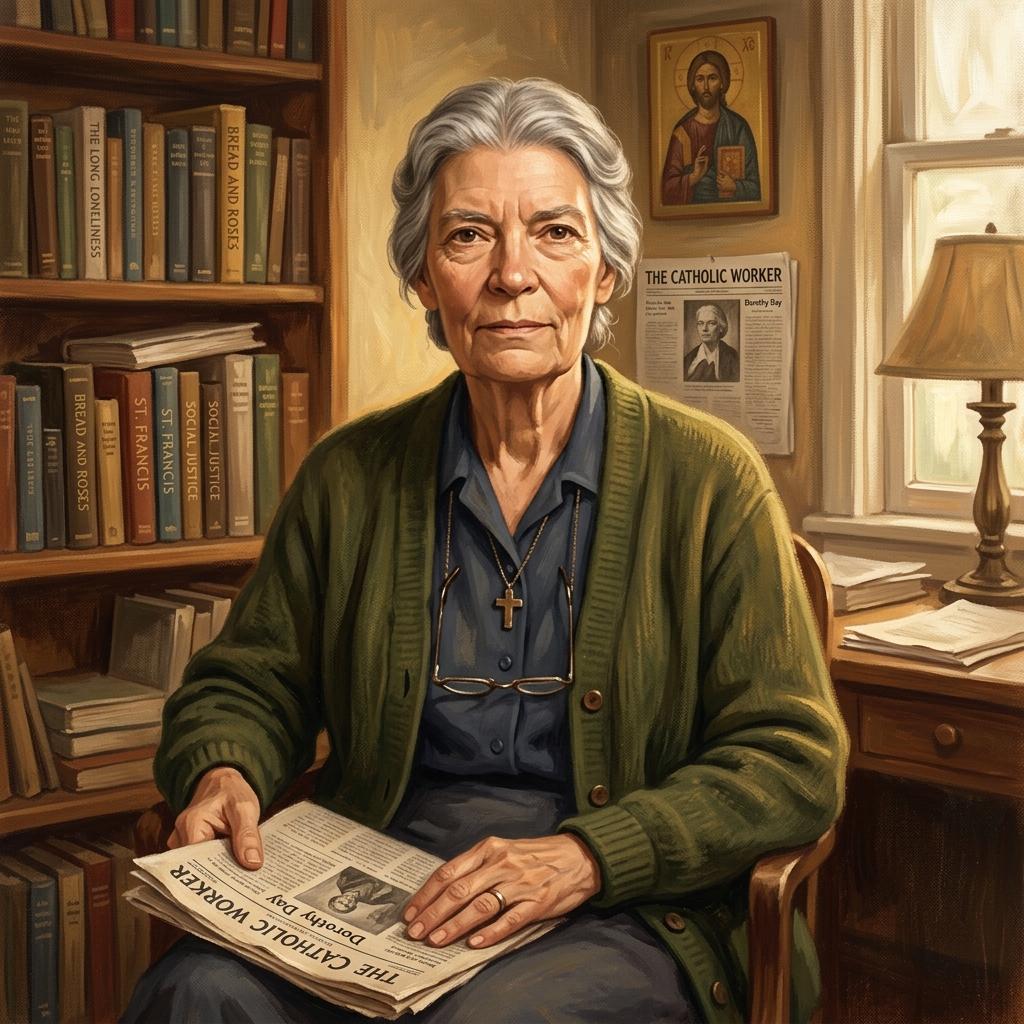
Dorothy Day on War, Poverty, and Mercy
Why Dorothy Day treated pacifism, voluntary poverty, hospitality, and the works of mercy as one Gospel commitment.
Dorothy Day did not treat peace, poverty, and mercy as separate causes. She understood them as one response to the Gospel: refuse to kill, share life with people who are poor, practice the works of mercy personally, and build communities where human dignity is more than an idea.
One Gospel commitment
It is tempting to divide Dorothy Day into roles: journalist, Catholic convert, antiwar activist, advocate for workers, and founder of houses of hospitality. Day resisted that separation. The same conviction ran through all of them: Christ is encountered in the neighbor, especially in the person whom society has made disposable.
This made her politics intensely personal. A society could not claim to value peace while abandoning people to hunger, and Christians could not outsource mercy entirely to institutions. For a fuller chronology, begin with our profile of Dorothy Day.
The works of mercy
The Catholic Worker houses that grew from the newspaper offered food, shelter, conversation, and community. The work was deliberately concrete. Feeding a hungry person was not a symbol for a future social order; it was obedience required now.
Day also knew that direct service could become sentimental if it ignored unjust systems. The newspaper joined hospitality to labor reporting, criticism of militarism, and calls for a social order built around human need rather than accumulation.
Voluntary poverty
Voluntary poverty was Day's attempt to narrow the distance between the helper and the helped. It meant simple living, shared risk, and fewer protections from the consequences of social failure. She did not romanticize involuntary deprivation; she challenged Christians to relinquish comfort that isolated them from their neighbors.
The practice also protected the movement's independence. Catholic Worker communities were intentionally decentralized and supported by voluntary gifts, allowing them to serve and protest without becoming another large institution.
Pacifism in wartime
Day's pacifism became most costly when the United States entered the Second World War. She maintained the newspaper's opposition to war even as readers, volunteers, and houses left the movement. Her position was not that the aggressor's evil was unreal; it was that Christians could not defeat dehumanization by accepting the deliberate killing of other human beings.
She later supported conscientious objectors and opposed nuclear weapons and the Vietnam War. The consistency mattered to her: enemy-love could not be reserved for conflicts in which it was socially acceptable.
Community instead of abstraction
Day's strongest answer to violence was a community in which people practiced another way of living. Meals, prayer, publishing, protest, and shared hardship belonged together. Peace became credible through habits and relationships rather than declarations alone.
Her example still asks an uncomfortable question: what would change if mercy toward the person in front of us carried the same weight as our opinions about distant events?
Sources
Continue with prayer
Peace begins with attention. Build a daily habit of pausing for prayer before distraction.
Explore Prayer Lock