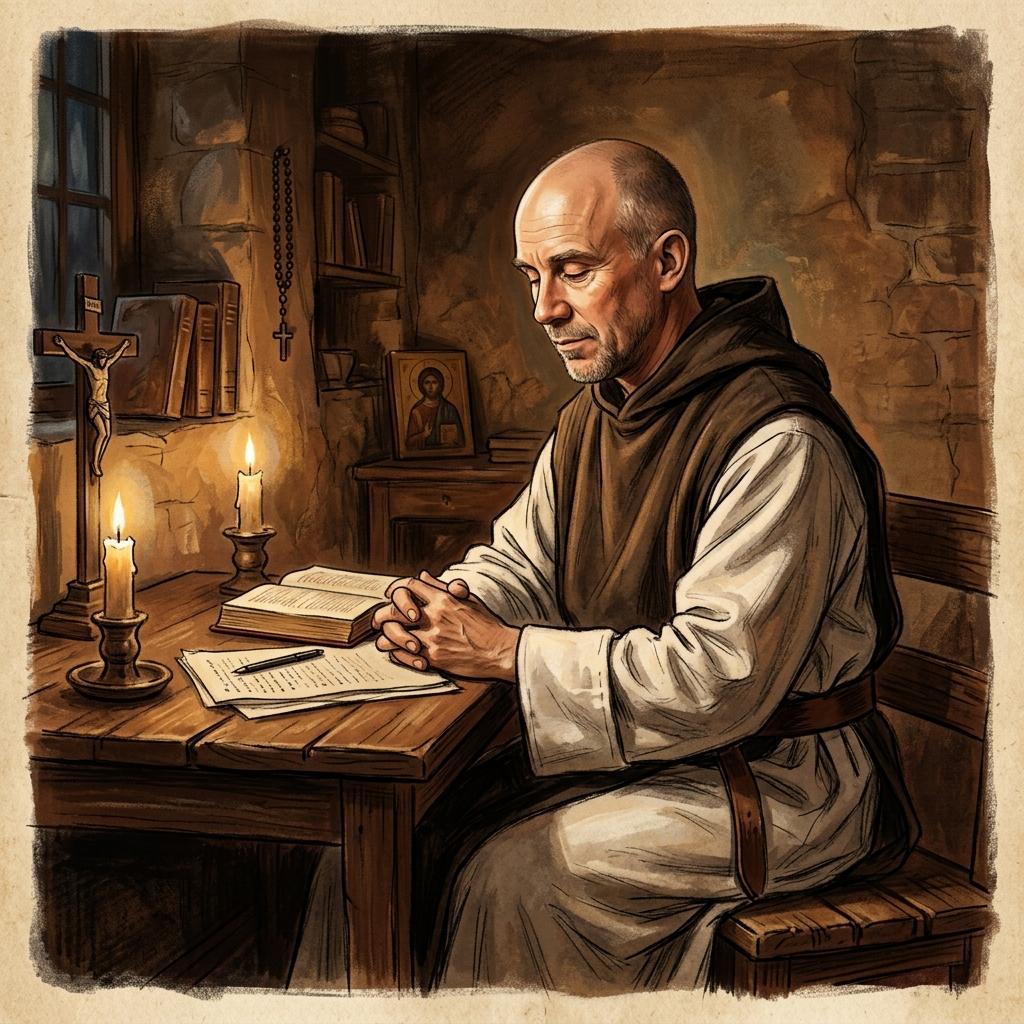
Thomas Merton and the Inner Life of Peace
How contemplation exposes fear, ego, and compulsion—and becomes a foundation for outward peacemaking.
Thomas Merton believed that outward violence grows from inward fear, illusion, and the compulsion to defend a false self. Contemplation does not withdraw from the world; it exposes those roots and makes truthful solidarity possible. The inner life becomes a school for peacemaking because it loosens the ego's need to dominate, perform, and divide.
Contemplation is not escape
Merton entered the Trappist monastery seeking silence and God, but his mature writing rejected the idea that contemplation permits indifference to the world. Silence was valuable because it made reality harder to evade: one's own motives, the dignity of other people, and the social systems that conceal violence behind respectable language.
His contemplative vocation therefore widened into writing about racism, nuclear weapons, war, technology, and interreligious understanding. For a broader biography and reading list, see our profile of Thomas Merton.
The roots of violence
“The root of war is fear,” Merton wrote. Political violence has public causes, but it also draws energy from the frightened self: the need to secure identity by defeating an enemy, the inability to accept vulnerability, and the fantasy that control can finally eliminate uncertainty.
Inner peace is not a private substitute for justice. It is freedom from the reflexes that reproduce the very violence a person opposes. Without that freedom, even peace activism can become driven by contempt, exhaustion, and the desire to dominate opponents.
Attention and the false self
Merton contrasted the constructed identity—maintained through status, comparison, and approval—with the deeper self received from God. Constant performance strengthens the constructed self because it turns every encounter into evidence for or against our worth.
This makes his work strikingly relevant to digital life. Feeds invite comparison, outrage, and endless self-presentation. A practice such as prayer before scrolling is small, but it interrupts the demand to perform and returns attention to a life that is already given.
From monastery to public witness
During the nuclear tensions of the 1960s, Merton corresponded with peace and civil-rights figures and circulated essays on war even when publication was restricted by his religious superiors. His authority came partly from refusing the easy choice between contemplation and action.
The contemplative sees the enemy as a person before seeing a category. That recognition does not erase conflict. It changes how conflict is entered: without denying truth, but also without surrendering to hatred.
A Merton-inspired practice
- Sit without input for two minutes.
- Notice the identity you are trying to defend or prove today.
- Name the person or group you have reduced to a category.
- Ask for the grace to see that person truthfully without abandoning your convictions.
- Choose one action that joins inner honesty to outward peace.
Sources
Make this a daily practice
PeaceDocs helps you learn the Christian tradition of peace. Prayer Lock helps you practice it — by pausing you for prayer before opening distracting apps.
Get Prayer Lock